Triple Products of Eigenfunctions and Spectral Geometry
 Joe Schaefer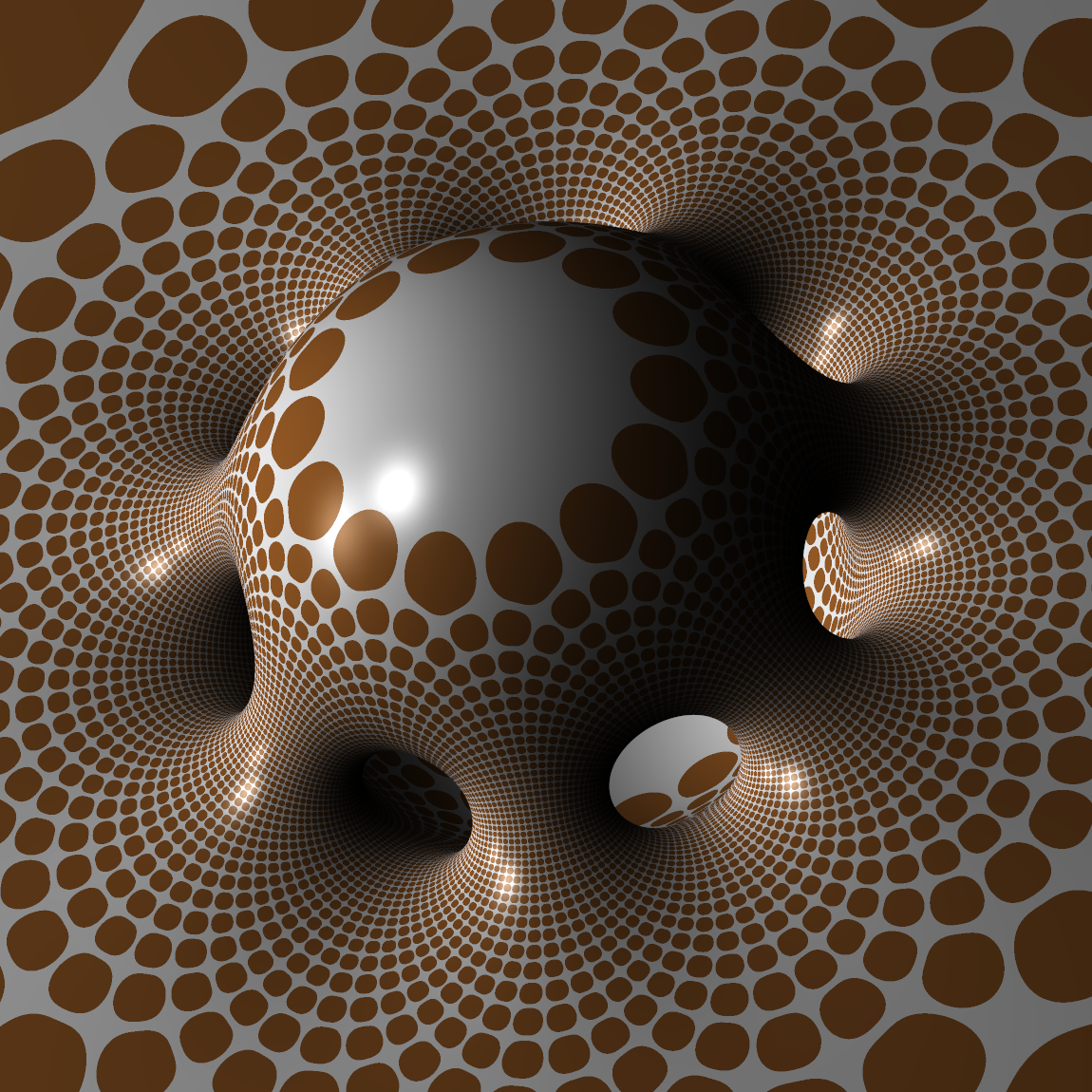
Lawson's minimal surface ξ6,1 stereographically projected from S3 to R3
Author
Joe Schaefer
Dedication
To Autumn
Abstract
Using elementary techniques from Geometric Analysis, Partial Differential Equations, and Abelian Algebras, we uncover a novel, yet familiar, global geometric discriminant — namely the indexed set of integrals of triple products of eigenfunctions of the Laplace-Beltrami operator, to precisely characterize which isospectral closed Riemannian manifolds are isometric.
Introduction
For a closed Riemannian manifold , characterizing its class of non-isometric, isospectral manifolds is a type of Inverse Problem [DH11] in Spectral Geometry. Naïvely one might speculate that this class would always be empty. However, the academic literature is rich with decades-old constructions of specific pairings of counterexamples: beginning in 1964 with John Milnor’s 16-dimensional pair of non-isometric, isospectral flat tori [JM64], and continuing [CS92] towards the generic dimensional characterization of flat tori in Alexander Schiemann’s 1993 doctoral thesis [AS94] — replete with a computer aided search for the critical case. A modern survey of the full flat tori history appears in [NRR22].
Along the way were insightful offshoots into more sophisticated, non-Euclidean symmetric covering spaces; constructing such isospectral, non-isometric “duets” involving nontrivial curvature tensors (and their spectrum-determined Euler characteristics in dimension 2 [MS67].) A prime example of this effort was Toshikazu Sunada’s 1985 [TS85] invention of a general-purpose covering space framework, which he then deployed in the same work to construct hyperbolic duets in dimensions 2 and 3.
For inhomogeneous Riemannian metrics, Carolyn Gordon discovered duets that are not even locally isometric [CG93].
Work continues in many related areas [DH11], such as determining topological characteristics of the class of isospectral, non-isometric manifolds in general (empty [ST80], finite [AS94], rigid [GK80], and compact [GZ97]) as a subset of different moduli spaces of Riemannian metrics.
What we offer in this article is a new perspective on a familiar tool: indexed Fourier coefficients of pairwise products of eigenfunctions as a discrete “algebraic/topological discriminant” to complement the existing, discrete “analytic invariant” — the non-negative spectrum of the Laplace-Beltrami operator (herein referred to as the Laplacian) on . Combined, we observe the pair provides a “discrete global geometric representation” of the isometry classes of isospectral, closed Riemannian manifolds.
Results
Given a (non-decreasing on the eigenvalues) orthonormal basis of eigenfunctions for the (non-negative) Laplacian on associated with a closed Riemannian manifold , define
To be isometric to , it is a necessary and sufficient condition for another isospectral closed Riemannian manifold to have an orthonormal basis of eigenfunctions (for its Laplacian) that both preserves the associated eigenvalues and possesses an invariant under each basis.
It is important to recognize is not basis-invariant: there is a natural unitary change-of-basis action on it discussed in detail after the proof of this Theorem. The discussion incorporates certain sets of basis-invariant singular values that one might form a general conjecture around, which claims that that ordered set of singular values completely characterizes the set of isospectral manifolds.
Regardless of the sufficiency half of the general conjecture, necessity is always the case. Which means these collections of singular values defined by and associated to every eigenspace triple are a new set of Riemannian invariants.
The hard work ahead for future research is in locating such basis pairs, or in determining that such pairs cannot exist at all, just by examining the properties of the in evidence. But this paper puts that target front and center: we seek to reduce the analytic geometry questions of Spectral Theory to computationally tractable linear algebra questions about products of eigenfunctions.
Symmetry plays an important role in computationally tractable cases [TF17] [LS18] [PS94], which is aptly illustrated in our flat tori Example below. However, the strength of our approach is perhaps best made apparent in the case of manifolds with the fewest number of Riemannian symmetries, which is the generic case. In this instance, we offer the following
(Diagonal Litmus Test) Given a pair of eigenvalue preserving orthonormal bases as described in the hypothesis of the Theorem, the manifolds are isometric if for every choice of , the product agrees in both bases; and if the vector space spanned by is dense in . Here represents the eigenfunction in the triple-product integral computations.
Furthermore, if we define as the Hilbert space generated by , if an only if the adjoint map
is injective.
Generically, isospectral manifolds are isometric if and only if the products as defined in Corollary 1 agree as real values.
The motivation for the study of is loosely derived from the study of the role of the bilinear multiplication operator in the definition of a Vertex Operator Algebra [FBZ04] associated with a Chiral Conformal Field Theory. Here is the Vector Space of States and is the space of formal Laurent series in with coefficients in . Since often comes equipped as a Hilbert Space with a traditional Fourier series orthonormal basis, indexing using the Fourier basis elements of is only slightly more involved than the case studied here, but quite similar in spirit. However a detailed comparison is out of scope for this article.
If we consider the map
this paper establishes the injectivity of this map for closed Riemannian manifolds (up to Riemannian isometry in its domain). Further results which apply these techniques to describe its image (and inverse), within select moduli spaces of metrics, are just getting started [AA25]. There, Anshul Adve rigorously tackles unit tangent spaces of compact, hyperbolic 2-orbifolds using these same structure constants from Conformal Field Theory.
Some imagery may be helpful here. If we fix and look at the orbits of under spectrum-preserving change-of-basis unitary transformations on , we see that the orbits of different isospectral pairs partition the image of this map along isometry classes.
Finally, we prove that the generic Riemannian metric case is completely characterized by the study of the “diagonal” .
These results were first demonstrated during a similarly titled talk by the author at MSRI in 1997, but they appear here in published form for the first time.
Preliminaries
Now with as above, for and note that the Fourier coefficients
since is uniquely representable as its rapidly converging Fourier Series (-specific Sobolev Embeddings [MT13] [RS75], together with Weyl’s Asymptotic Law [HW11], imply the terms in the sum are uniformly in [LH68], .) Then we see that for , the Fourier coefficients of the pointwise product are
and so, critically, any multivariate polynomial (on smooth functions) commutes with any spectrum-preserving -eigenfunction orthonormal basis map that preserves :
Moreover if is Borel-measurable, then the results above hold pointwise for the characteristic function of everywhere except along the boundary of : if and ,
and by uniqueness, we have the following identity
This implies any such basis map as above carries characteristic functions (as members of ) to characteristic functions in a measure-preserving fashion.
The point of these computations is to emphasize the fact that characterizes the Harmonic Analysis of the pointwise multiplication operator on , which is a dense subalgebra of the Abelian algebra , by the Stone-Weierstrass theorem.
For the rapid convergence of these above sums involving , note that products of eigenfunctions are smooth, so these Fourier coefficients decay as above (in each index). For more details, see Emmett Wyman’s work in 2022 with these coefficients as it relates to the triangle inequality on the eigenvalues [EW22].
Note: we may always assume
where is the Kronecker delta. Since is a spectral invariant [HW11], this information is already available from isospectrality considerations.
Proof of Theorem
For necessity, let be an isometry between closed Riemannian manifolds, and let the target orthonormal basis of eigenfunctions on be the pull-back via of the orthonormal basis on above. Since
we are done with the necessity argument because .
For sufficiency, we now consider the linear, bijective orthonormal eigenfunction basis map from to and note that from the calculations in the Preliminaries above, preserves pointwise products for smooth functions (and preserves characteristic functions when extended to ) by the premise that is invariant under this map.
Lemma
preserves the uniform norm.
Proof of Lemma
Let be a smooth partition of unity on .
Thus (Kronecker delta).
By the dominated convergence theorem,
which is a characteristic function of positive measure on each disjoint subset . This means the Lemma is proven for each , since the limiting characteristic function of a set with positive measure is preserved, and hence has uniform norm 1, as do all , by Diagram (6).
Without loss of generality, we may apply the special case result shown for the smooth partition of unity , where has positive measure, and the Lemma is proven in full.
Since is also a Fourier basis for , it is clear from Equation (4) that . This means that on a dense set of (and ), we have established as an isomorphism of Abelian algebras, and thus can be extended to an isomorphism of and in the same category.
Now we apply the Gelfand-Naimark-Segal Representation Theorem (in contravariant functor form) for unital Abelian algebras [JC19] to represent this isomorphism by a homeomorphism between and . Since it is bijective on smooth functions, it too must be smooth.
As this now diffeomorphism preserves eigenvalues and eigenfunctions (by hypothesis on ), it must preserve the Laplacian on smooth functions. Hence it also must preserve the principal symbols of these same elliptic operators [MT13]. The principal symbols of the Laplacian are simply another means of expressing the Riemannian metric on the manifolds in question.
This completes the proof of the Theorem.
Discussion of Corollaries
With and representing the two triple-product sets for the bases and , let be the action on such an orthonormal basis . Thus, we will choose so that yields .
Why is this the case? In general, the symmetry group acting on the space of possible orthonormal bases of eigenfunctions is the space of Unitary Operators that commute with projections onto the finite-dimensional eigenspaces associated with each individual eigenvalue of the Laplacian. Therefore
is the image of under ’s basis action .
Now under the conditions of Corollary 2, each of the are one dimensional vector spaces over , but that also means they are one dimensional vector spaces over , and so the full multiplicative symmetry group is .
More generally, the associated prerequisite “regarding agreement in product values” would simply become “preservation of the ordered set of singular values (counted with multiplicity) of the linear maps from defined by .” Here the inner product on is . By definition, these singular values are invariant under direct sums of unitary transformations on the .
In the multiplicity-1 spectrum case, the complete set of singular values is simply the set of absolute values of which, we still conjecture, completely characterizes the isometry classes of such isospectral manifolds. See Equation (21) for the key relationship between this conjecture and Corollary 2. What’s missing is the sufficiency argument that if the absolute values agree, the manifolds are isometric; which requires an argument to eliminate possible sign change cancellations between bases in the LHS summands of Equation (21).
We are significantly less confident that the general conjecture holds true (outside the multiplicity-1 spectrum case), since it may be possible to produce a counterexample (of sufficiency) via explicit Sunada construction.
If the index notation is obfuscating the situation, perhaps this basis-independent description will help. Take and consider the expression
Recall that each is a finite dimensional complexified Euclidean space. All does is provide basis coordinates of this basis-independent expression. Since , what the Theorem says is that the above expression is identical between manifolds if and only if the manifolds are isometric; which should come as a shock to literally no one. The sufficiency half of these conjectures are largely combinatorics problems involving reconstructing these expressions purely from their singular value decomposition.
However, these basis invariants may prove useful in deciphering more complex cases involving proving two isospectral manifolds are not isometric, by showing that their singular values are not identical between the two bases in question.
Aside
The Representation Theory of a Compact Lie Group takes the explicit Laplacian out of the equation and studies -invariant (under left or right action) irreducible decompositions of (here is the normalized Haar Probability Measure on ) as , and honors their interplay in the expression above as the essential artifacts of Lie Theory, as addressed in the Peter-Weyl Theorem [AK01]. Compatible Riemannian geometries are generated by convenient choices of quadratic Casimir elements that lie in the center of the universal enveloping algebra, which are of less significance than the irreducible decomposition itself. Their spectral decomposition is a (less convenient) reassembly of those irreducible components, since the associated Cartan-Killing Casimir element is constant on each irreducible component.
Wigner’s symbols for are a prime example for further study — let us apply our general construction to it as a group manifold. Every finite-dimensional irreducible unitary representation of is labelled by a non-negative half-integer . We write for the -dimensional space on which this representation acts. A standard orthonormal basis of is the magnetic basis with
The equation
expresses the symbol definition in terms of Clebsch-Gordan Coefficients , which have closed form expressions such as Racah’s formula that underpins modern numerical software libraries [JF16].
A symbol vanishes unless , the triangle inequalities hold, and is an integer.
From the point of view of the compact group , the symbols are precisely the (properly normalized and phased) intertwining operators that realize the unique (up to scale) invariant subspace of the triple tensor product when that product contains the trivial representation. They are therefore the natural “structure constants” for the fusion of three irreducible representations to the singlet.
This is exactly analogous to the rôle played by the triple-product integrals on a Riemannian manifold: they are the structure constants of the pointwise product of eigenfunctions when that product is expanded back in the eigenbasis. On the group itself, those integrals reduce to the -symbols.
To wit, let be the standard Wigner -functions (matrix coefficients of the irrep of spin ). With respect to the normalized Haar probability measure one has the exact formula
(The overall phase convention can be adjusted by the usual Condon–Shortley factors; the essential point is that the integral factors into a product of two real -symbols.) When the indices of the paper run over a complete orthonormal basis of matrix coefficients ordered by increasing (and then by magnetic indices ), the quantities are precisely the numbers appearing on the right-hand side above.
The Peter–Weyl theorem supplies a complete orthonormal basis of given by the renormalized matrix coefficients:
where the indices run over
Combining the two equations one obtains the explicit expression:
For compact Abelian Lie Groups, these irreducible components are all one-dimensional, so their situation is entirely similar to the spectral decomposition of multiplicity-1 Laplacians above. More on this in the Example below.
Getting back to Corollary 1, we observe that the proof involves establishing this implication:
We may hope that for any given , cannot be identically for all , since it is a generically true condition, but false for specific cases like the flat tori case covered in the Example below. A higher-level way of looking at this condition is to note that such a hope-violating would have in the kernel of the adjoint map . Furthermore, the Formula for requires both -independence, and sufficiency, to establish the basis map preserves .
We sketch a proof of Corollary 1 (sufficiency) below the next set of formulae.
Nevertheless, let us compute some relevant identities so some intrepid future researcher can dig into the generalized conjecture:
Note: for the one-dimensional flat-tori case below, since is a true derivation.
Proof of Corollaries
Now consider the famous associativity relations from Conformal Field Theory:
Corollary 1 follows from the fact that is well-defined (i.e. -invariant by the hypotheses on products), and the prior observation that the algebraic, bounded trilinear operators defined by and are both associative, and agree with pointwise function multiplication by squares of absolute values of eigenfunctions, which is dense in . Establishing is exactly equivalent, where is the closed Hilbert space generated by , and is the change-of-basis identity map.
So they agree everywhere.
Corollary 2 sufficiency follows by noting that the vanishing adjoint-map kernel condition in Corollary 1 is generically true. And if for some choice of , the product disagreed between bases, they would disagree in every pair of bases.
Why? Since generic manifolds can be presumed to also have multiplicity-1 spectra, this reduces the full symmetry group to where these products are invariants, contradicting Theorem 1. Further reduction to via real-valued bases ensures the products are real-valued. This establishes the necessity of the hypothesis, and completes the proof.
Further, the arguments in the proof of Corollary 1 are valid even when the manifolds are non-isospectral, so we can represent the basis map as a diffeomorphism if and only if the products match in the generic case above. Isospectrality then becomes equivalent to this diffeomorphism being a Riemannian isometry.
This completes the proof of the Corollaries.
Example
Let be an indexed, rank lattice of Lie Algebra weights for the quotient space representation of as translation invariant (i.e., constant) vector fields on itself, when is also viewed as ’s associated Lie Group over a torus defined by . These weights define integrable lifts of 1-forms over the torus that integrate to linear functionals as its Lie Group (covering the torus). These linear functionals can then be uniformly rescaled (by ) and exponentiated to form multiplicative characters that descend to form an orthonormal basis of , with Lebesgue (Haar) measure .
Moreover, this basis simultaneously diagonalizes the flat torus’s Laplacian because the Laplacian is the image of a symmetric, negative-definite quadratic Casimir element under this (constant coefficient linear differential operator) quotient space representation of the universal enveloping algebra. Hence, its eigenvalues are in constant proportion (of ) to the Casimir-element-determined-length-squared of each character’s weight in the lattice.
We presently view the above basis
to be our Theorem-applicable Fourier basis of orthonormal (multiplicative character) eigenfunctions (of this quotient representation of the (negative) Euclidean Casimir element) directly corresponding to . By our Theorem’s hypotheses, we must have (with the Euclidean norm on the weights).
Now we can compute
As this Equation only depends on the weight lattice itself, it is orthonormal-basis-index invariant. Further, it is only invariant under linear transformations on the weight lattice , so only an orthonormal eigenfunction basis map which is induced from a volume-preserving invertible linear map between two such indexed, rank weight lattices will keep the “algebraic/topological” indexed data set invariant.
However, in order to apply our Theorem, it is essential that such a linear map be on the weight lattice, because the induced eigenfunction basis map
must also preserve the “analytic” invariants — the Casimir-element induced figure for each indexed weight, i.e. the individual eigenvalues of the flat-tori’s Laplacian.
As Milnor’s duet exemplifies, having a map which preserves the lengths of the lattice weights is not sufficient to deduce the map is in ; we must also know that the map preserves lattice weight angles. But this is a consequence of the formulae developed in Equation (20):
The neat thing about this analysis is that we’ve proven there is no linear map between lattices that preserves the eigenvalues without the map being induced by a Riemannian isometry on the tori — as a consequence of the Theorem, not because the explicit computations involved are simple polarization identities.
This representation-theoretical account [AK01] is exactly equivalent to the prior development of lattice congruence [NRR22] traditionally used to delineate isometry classes of flat tori. In fact, the matrix transpose of such a linear map , as described in the prior paragraph, is the contravariant Riemannian isometry between the tori, as provided by application of the Gelfand-Naimark-Segal Representation Theorem during the Proof of our Theorem.
Acknowledgements
The original research was funded in part by a gracious James Simons Research Award in 1995-1996, and the generous support of an Alfred P. Sloan Dissertation Fellowship in 1996-1997 at the University at Stony Brook.
The author would also like to thank Tanya Christiansen, Carolyn Gordon, Hamid Hezari, Harish Seshadri, and especially Leon Takhtajan for their technical assistance and review in the preparation of this manuscript for publication.