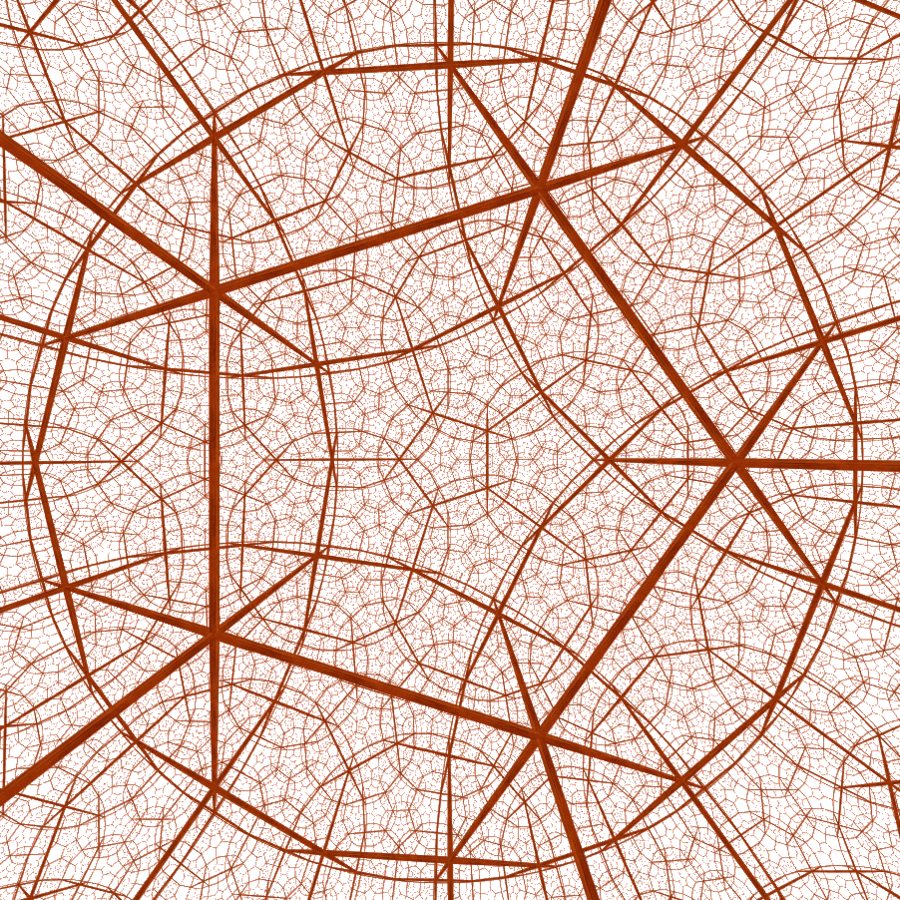
// tubular trefoil knot -*- asy -*-

import tube;
import graph3;
import palette;

size(0, 8cm);
currentlight=White;
real redPortion = 143 / 256;
real greenPortion = 153 / 256;
real bluePortion = 251 / 156;
pen periwinklePen =  redPortion * red + greenPortion * green + bluePortion * blue;
// currentlight.background = periwinklePen;
currentprojection=perspective(1,1,1,up=-Y);

int e=1;
real x(real t) {return cos(t)+2*cos(2t);}
real y(real t) {return sin(t)-2*sin(2t);}
real z(real t) {return 2*e*sin(3t);}

path3 p=scale3(2)*graph(x,y,z,0,2pi,50,operator ..)&cycle;

pen[] pens=Gradient(6,red,blue,purple);
pens.push(yellow);
for (int i=pens.length-2; i >= 0 ; --i)
  pens.push(pens[i]);

path sec=scale(0.25)*texpath("$\pi$")[0];

coloredpath colorsec=coloredpath(sec, pens,colortype=coloredNodes);

draw(tube(p,colorsec),render(merge=true));
My 1997 Ph.D. thesis as a blog entry.
There Is Only One n-Dimensional Wiener Measure μ
Piecewise Linear Approximations to Brownian Motion
The Development Map DM
The Cameron-Martin Formula
Heat Kernels as Radon-Nicodym Derivatives of Weiner Measure
Notation
M is a negatively curved dim=n closed Riemannian manifold with metric g, metric connection ∇, and (nonnegative) Laplace-Beltrami Operator ΔM. Let k−tΔ/2(x,y) represent the heat kernel on M.
Hence k−tΔ/2(x,x)=dDM∗μ/gdx is the Radon-Nicodym derivative of n-dimensional Wiener Measure μ, restricted to the pull-back of continuous loop space Ωt(M)∣x, via the inverse of the Weiner measure-preserving development map DM. Note:DM−1Ωt∣x is not a loop space in general.
Ωt0 is the space of continuous contractible loops on M.
Ωt[γ] is the space of continuous loops on M homotopic to the closed geodesic γ. Let γ0 be its primitive loop.
DM−1Ωt0[γ] is the preimage of continuous contractible loops on M written as offsets homotopic to γ(s)=DM(tsℓ(γ)e1),0≤s≤t. Think Horocyclic Coordinates — each fiber as the geometric limit of periodic geodesic spheres Sγ0(s)n−1(kℓ(γ0)),0≤s≤t,k→∞, vectorized in the Normal Bundle over γ0. Our curvature constraints imply Horocyclic Coordinates for every γ0 exist as a smooth, DM-compatible coordinate map for Ωt0[γ]. In horocyclic coordinates, detg(x)=1:
IMPORTANT Therefore, when h=h(y), the parallel transport equation reduces to c˙(t)=−α(γ˙(t))c(t)=−∂y(hdx/dt+h2/2dy/dt)c(t). Of course, this has closed solution
Z−Δ/2(t)=DM∗μ(Ωt)DM∗μ(Ωt0)DM∗μ(Ωt[γ])=DM∗μ(Ωt0)+{γ}∑DM∗μ(Ωt[γ])≈t→0(2πt)−n/2(vol(M)+t/6∫MK(x)gdx+O(t2))by McKean-Singer=e−ℓ(γ)2/2t∫MDM∗μ(et⟨JBBt∣Bt⟩Ωt0[γ]∣xgdx) by Cameron-Martin=e−ℓ(γ)2/2t∫Tγ0ME(etJB∣Ωt0[γ]∣x(τ))dx1(τ)…dxn(τ)dτ

 Joe Schaefer